
Schmidt & Sons included in state attorney general’s efforts to help pharmacies
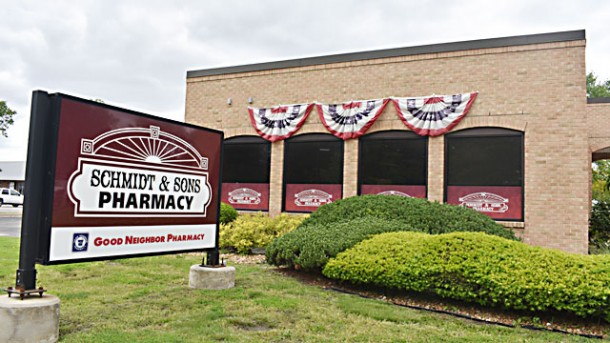
The Schmidt & Sons Pharmacy location in Blissfield closed in April. Photo by Brad Heineman.
How pharmacy benefit managers have affected local pharmacies is well known to the Schmidt family, owners of Schmidt & Sons Pharmacy in Tecumseh.
What they did not know was that the Michigan Attorney General’s Office would use their business’s situation in a recent lawsuit against two PBM companies as an example of what has been happening to pharmacies over the past 20 years.
“The retail pharmacy landscape in the United States has been decimated over the last 20 years,” the lawsuit says. “About one in three of all retail pharmacies have closed since 2010. Since 2023, independent drugstores have been closing at a rate of almost one per day. Between 2013 and 2022, 10% of all independent pharmacies in rural areas went out of business.
“Michigan is no exception. Only 771 independent pharmacies remained in the state by the end of 2023. And 91 of them permanently closed their doors between January and August 2024.
“For example, Schmidt & Sons Pharmacy, a family-owned business that has served Michigan residents for over five decades, and at one time operated four locations in Blissfield, Clinton, Tecumseh, and Dundee. Together, these locations employed more than 60 people. But due to increasingly low reimbursement from PBMs, Schmidt & Sons has been forced to close all but one location. Commenting on their Blissfield branch closure in April 2025, Schmidt & Sons Pharmacy said, ‘Sadly, decreased reimbursement, without congressional PBM (pharmacy benefit managers) reform happening soon enough, has forced us to add Blissfield to the long list of towns in this country without a community retail pharmacy.”
Harvey Schmidt, president and co-owner of Schmidt & Sons, said he left a voicemail message before the lawsuit was filed for one of the assistant attorneys general who filed the lawsuit in U.S. District Court, but did not hear back from him. He found out about the lawsuit from another pharmacist who emailed it to him.
“I immediately sent a thank-you note email to Dana Nessel,” Schmidt said, referring to the Michigan attorney general. “And then that night, when I got in bed, I thought to myself, ‘I’m going to read this.’ And I started reading it, and I got down to item 47 and there we were.”
In lawsuits, each paragraph is numbered for easier reference.
The lawsuit was filed against two PBMs — Express Scripts Inc. and Prime Therapeutics LLC – for allegedly engaging in anticompetitive conduct that restricts patient access to medications and increases the cost of obtaining prescription drugs, according to the news release announcing the lawsuit. It accuses the two PBMs of forming an unlawful agreement that suppressed reimbursement rates to independent pharmacies. This allegedly enabled the PBMs to make excessive profits and contributed to the closure of pharmacies in Michigan and across the nation.
The role of PBMs today is not how they initially were conceived. According to the lawsuit, “When PBMs first emerged in the 1960s and 1970s, they primarily processed pharmacy reimbursement claims for health plans. But the role of PBMs has expanded dramatically. Today, PBMs play a major role in designing pharmacy benefits for health plans and determining the prices that health plans (and their members) pay for prescription drugs.”
“Coming this October, I will have owned the pharmacy for 49 years,” Schmidt said. “And it’s more than upsetting that we built this business. Built it, built it, built it. And then, cut by cut, the PBMs have taken what we built away from us, and it’s very upsetting.”
Three PBMs – Caremark, Express Scripts and OptumRx – are responsible for processing nearly 80% of all prescription drug claims to insurers, according to the lawsuit.
“Given the current level of PBM consolidation, pharmacists, health insurers, and drug manufacturers have little choice but to interact with the large, dominant PBMs when purchasing or distributing prescription drugs,” the lawsuit says.
The PBMs also have become vertically integrated with other parts of the health care industry, meaning they are often part of the same corporate families as pharmacies, insurance companies and other businesses, the lawsuit says.
Now, co-owner and vice president Sam Schmidt said, they have situations where they will dispense a medication that cost the pharmacy $100 to buy from the manufacturer but a PBM has decided the pharmacy will only get $10 from the insurance company.
“I imagine they’re still charging Blue Cross, or whoever the insurance is, for the $100 price, right?” Sam Schmidt said. “And then keeping $90 and giving us $10. That’s ridiculous.”
Carrie Schmidt, a pharmacist at Schmidt & Sons and Sam’s wife, said her pharmacist friends who work in hospitals or other nonretail locations don’t understand how this is happening.
“They’re like, ‘Well, that doesn’t make sense. Why aren’t you getting paid your cost?’” she said.
Schmidt & Sons started selling durable medical equipment – wheelchairs, walkers, CPAP machines and the like – in the 1990s as a hedge against the way prescription reimbursements from insurance companies weren’t keeping up with the costs. But even insurance reimbursements for those items are being chipped away, the Schmidts said.
One solution, they said, could be a law like one recently enacted in Arkansas that bans pharmacy benefit management companies from owning or operating pharmacies. Michigan passed a PBM reform law last year, Sam Schmidt said, that was “really good” but without anyone filing complaints with the state the enforcement has been weak.
A better solution would come from Congress, they said. Rep. Buddy Carter, a Republican from Georgia, is a pharmacist and has introduced legislation multiple times to try to address PBMs, but it hasn’t advanced.
“It’s really got bipartisan support all the time,” Sam Schmidt said, “but that’s why I’m struggling with why isn’t it even getting done? Like it doesn’t matter what side of the aisle you’re on, they agree that something’s got to be done. They just don’t do it.”
Some PBM reform measures are included in the “One Big Beautiful Bill Act” that recently passed the U.S. House.
The Schmidts are appreciative of their customers who have stuck with them even after they closed stores. When the Clinton store closed, the percentage of customers from there who stuck with them and filled their prescriptions at the Tecumseh location surprised them.
“Some of them, they’ve done it even though they can maybe get it cheaper somewhere else, or get it cheaper through mail order, because they appreciate the service,” Harvey Schmidt said.
They’re making 15 deliveries a day to Blissfield, Carrie Schmidt said.
“We want to keep providing the best possible service we can to our customers,” Harvey Schmidt said. “And the only thing that is in the way of that continuing, in my mind, are the PBMs.”
Category:
Contact Us


Advertise With Us
Advertise with us! Give us a call or an email to discuss our advertising rates and how we can help place an ad for you or start an ad campaign!
Classified Advertising Rate
0-10 words -- $9.75
11-20 words -- $12.25
21-30 words -- $14.75
31-40 words -- $17.00
41-50 words -- $19.75
More than 50? Give us a call to discuss further.
Same classified, no changes in copy — three weeks for the price of two.
Classified Ads — Tuesdays, noon E.S.T.
Advertising Rates and Discounts
Display advertising rate is $13.55 per column inch. We can help you design your ad, and design is free of charge. Contract discounts are available.
Advertising Deadlines
The deadline for the Thursday edition is Monday at 5 p.m. E.S.T. Attempts to accommodate late advertising past deadlines will be made but cannot be guaranteed.
Inserts — Full Circulation
$325 — Full Circulation
Pre-printed inserts should be delivered to The Tecumseh Herald by 5pm Mondays.
Total Print Circulation - 3,298
The Tecumseh Herald is distributed throughout Lenawee County. Each edition of the newspaper is printed and delivered to newsstands every Wednesday evening and to the U.S. Post Office for Thursday delivery to subscribers.
Billing
Terms: Net 30 days • Visa, MasterCard, American Express and Discover accepted.
Tecumseh Herald
Latest articles
-

The Clinton boys soccer team celebrates a goal during a match at home against Ida. Photo by Kristopher Lodes
Mon, 10/05/2026 - 9:37pm -
 Sat, 10/03/2026 - 8:45am
 -

Adrian's Luke Bruggeman carries the ball while Tecumseh's Cooper Lewis dives to attempt a tackle during the Week 6 game at Tecumseh. Photo by Deloris Clark-Cheney
Fri, 10/02/2026 - 11:46pm